


SDSB Speaker Session by Johanna Knoess (GIZ) on Adaptive Social Protection
Share


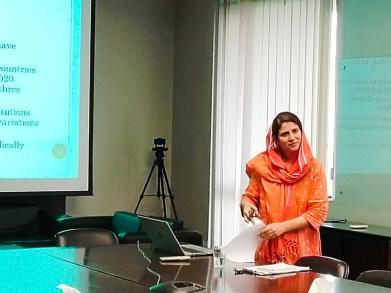
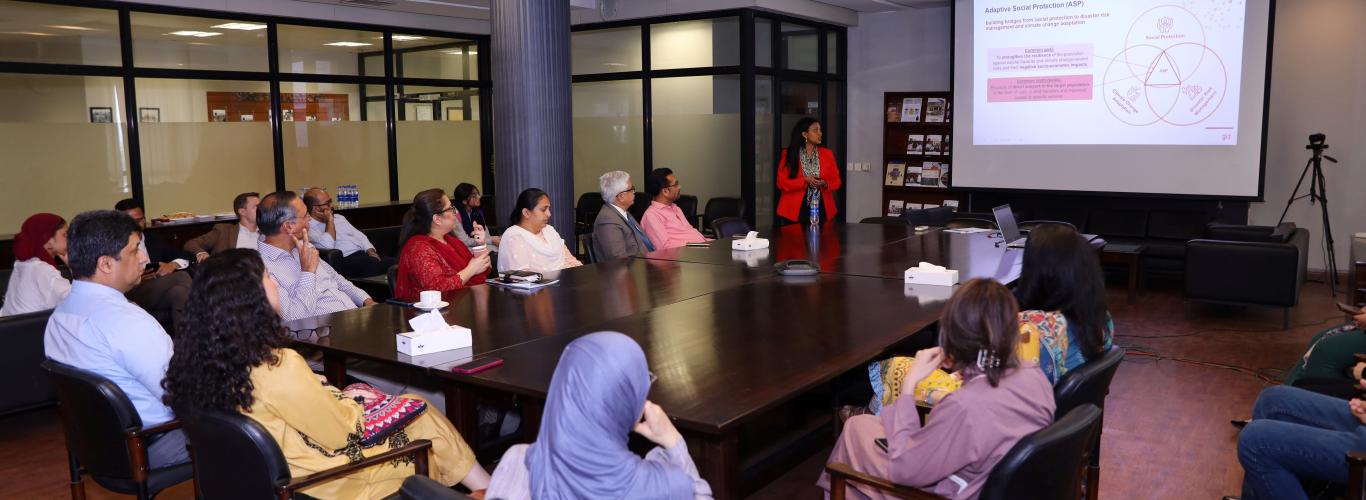
On April 28, 2026, the Suleman Dawood School of Business (SDSB) at LUMS hosted Johanna Knoess, Head of Adaptive Social Protection at GIZ Pakistan, for a guest speaker session on “Addressing Risk through Adaptive Social Protection: Lessons Learned and Good Practices.” The session brought together students and faculty for an in-depth discussion on the evolving role of social protection systems in addressing contemporary development challenges.
Johanna Knoess leads the Adaptive Social Protection project in Pakistan, working to strengthen institutional, financial, and technical frameworks for climate-resilient and inclusive social protection systems. She brings extensive experience across international development institutions, having previously led GIZ’s global advisory programme on social protection and worked with organisations such as the World Bank, the International Labour Organization (ILO), and KfW Development Bank.
The session focused on the transition from traditional, reactive models of social protection toward adaptive systems designed to anticipate and respond to shocks. Drawing on global experience as well as examples from Pakistan, Ms. Knoess highlighted how increasing climate variability, economic volatility, and demographic pressures are reshaping the way governments design and implement social protection programmes. She emphasised the need for systems that are not only responsive in times of crisis but also capable of strengthening long-term resilience.
A central theme of the discussion was the integration of social protection with disaster risk management and climate change adaptation. Ms. Knoess outlined how adaptive social protection seeks to bridge these domains by combining income support mechanisms with anticipatory planning, early warning systems, and coordinated institutional responses. This approach, she noted, allows governments to move beyond emergency relief toward more proactive and sustainable interventions.
Drawing on international case studies—including programmes in Brazil, Indonesia, Bangladesh, and Ethiopia—she demonstrated how well-designed social protection initiatives can reduce vulnerability, improve access to essential services, and support pathways out of poverty. These examples illustrated the potential of adaptive systems to scale effectively during crises while maintaining a focus on long-term development outcomes.
The session also examined Pakistan’s social protection landscape, including flagship programmes such as the Benazir Income Support Programme (BISP) and the Sehat Sahulat Programme. Ms. Knoess highlighted ongoing efforts to strengthen these systems through digitalisation, improved data integration, and enhanced coordination across federal and provincial institutions. She discussed initiatives such as mobile registration units and financial inclusion programmes that aim to extend coverage to vulnerable populations, particularly in the context of climate-related shocks.
A key takeaway from the session was the importance of institutional capacity and data systems in enabling adaptive responses. Ms. Knoess underscored the role of real-time data exchange, interoperability across agencies, and targeted identification of vulnerable populations in improving the effectiveness of social protection programmes. She also emphasised the importance of policy design that balances immediate relief with long-term resilience-building.
The discussion provided participants with an in-depth understanding of how social protection systems are evolving in response to increasingly complex and interconnected risks. By linking global insights with local realities, the session offered a comprehensive perspective on the challenges and opportunities in building resilient social protection frameworks.
The seminar formed part of SDSB’s broader efforts to engage with contemporary policy and development issues through academic dialogue and practitioner insight.
Other NEWS