


Stakeholder Session on Advancing Agri-Mechanisation through Indigenous Manufacturing in Punjab
Share


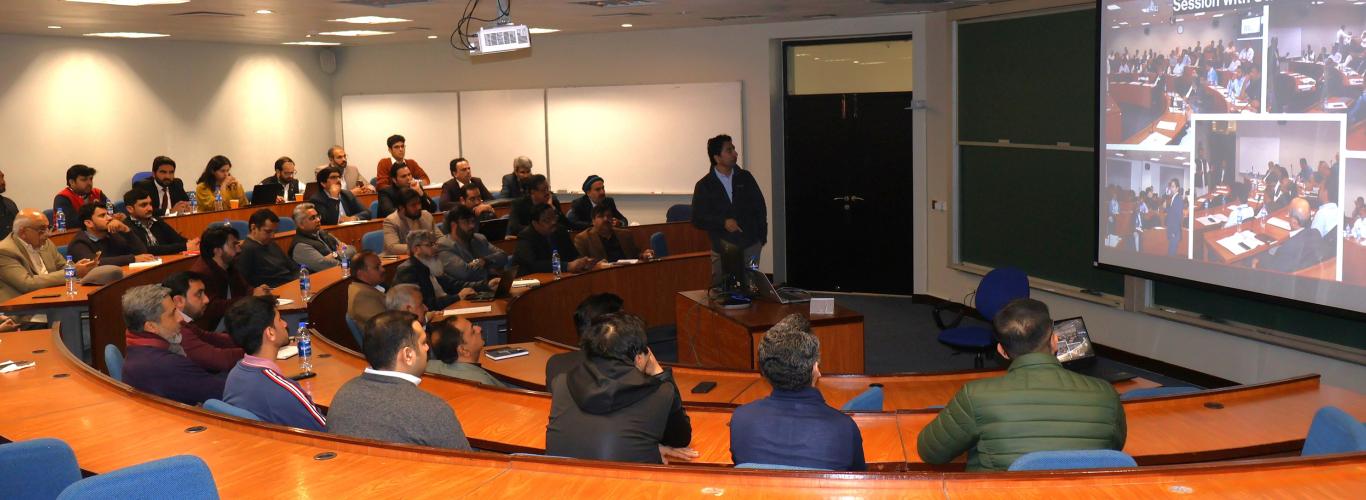
On January 9, 2026, the Suleman Dawood School of Business (SDSB), LUMS, convened a high-level Stakeholder Session on Agri-Mechanisation in Punjab as part of the research and policy project “Promotion of E-Mechanisation through Indigenous Manufacturing in Punjab.” The project is led by Dr. Shakeel Sadiq Jajja, Professor at SDSB, whose work focuses on operations, supply chains, and industrial development in emerging economies.
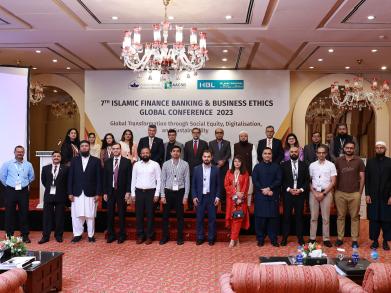
The session brought together a diverse and influential group of stakeholders spanning the entire agri-mechanisation value chain. Participants included senior government officials, representatives from leading tractor and agricultural implement manufacturers, service providers, agri-entrepreneurs, researchers, and development practitioners. This multi-stakeholder composition enabled a holistic and practice-oriented dialogue on the future of agricultural mechanisation in Punjab.
Moving Beyond a Tractor-Centric Model
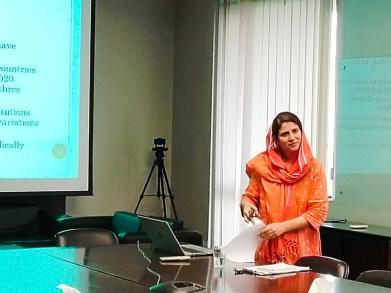
A central theme of the discussion was the need for Punjab to transition from a predominantly tractor-centric approach to a more balanced, technology-enabled mechanisation ecosystem. Drawing on extensive fieldwork, industry engagement, and policy analysis, Dr. Jajja anchored the conversation in evidence-based insights and on-ground realities, highlighting both structural constraints and emerging opportunities.
Participants emphasised that while tractor penetration in Punjab is relatively high, mechanisation remains uneven, particularly for small and medium farmers who lack access to affordable implements, specialised machinery, and modern services. The discussion underscored the importance of diversifying mechanisation across land preparation, planting, harvesting, post-harvest handling, and precision agriculture.
Indigenous Manufacturing and Service-Based Models
A strong focus of the session was on indigenous manufacturing as a cornerstone of sustainable mechanisation. Stakeholders examined how strengthening local manufacturing clusters can reduce costs, improve equipment suitability for local agro-climatic conditions, and generate employment opportunities. The need for testing and certification infrastructure was highlighted to ensure quality standards, build farmer trust, and support export potential.
Participants also explored service-based mechanisation models, particularly Custom Hiring Centres (CHCs), as a practical solution for improving farmer access without imposing high capital costs. Such models were discussed in the context of financing mechanisms, operational viability, and the role of the private sector in scaling services across rural Punjab.
Technology, Policy, and Partnerships
The session featured an in-depth discussion on the integration of emerging technologies, including digital platforms, drones, and precision agriculture tools, within Punjab’s mechanisation landscape. Stakeholders noted that technology adoption must be complemented by skills development, after-sales support, and predictable, long-term policy signals.
The presence of both public- and private-sector decision-makers facilitated candid exchanges on regulatory bottlenecks, financing constraints, and coordination challenges. There was broad agreement on the critical role of public–private partnerships and structured collaboration between policy, industry, and academia to accelerate impact.
Toward a Shared Roadmap for Punjab
A key outcome of the session was strong convergence around a shared roadmap for agri-mechanisation in Punjab. Participants aligned on priorities such as:
- Strengthening local manufacturing capacity and innovation,
- Expanding farmer access through scalable service delivery models,
- Investing in testing, certification, and skills development, and
- Ensuring policy coherence to support long-term industrial and agricultural transformation.
The session endorsed that agri-mechanisation is not only a productivity agenda, but also a strategic opportunity for industrial development, employment generation, and environmental sustainability. Insights generated through this engagement will directly inform actionable policy and industry recommendations, contributing to enhanced food security and positioning Punjab as a regional hub for agricultural machinery and innovation.
Other NEWS